There’s a piece of advice so common it has become ambient noise:
You can only change yourself.
It’s usually offered as consolation. Sometimes as instruction. Occasionally as rebuke. The implication is always the same: the interior is where the work lives. Your reactions, your attitude, your interpretation of events. If the world feels difficult, look inward.
There is something true in this. There is also something it misses entirely.
Because sometimes the world isn’t responding to who you are.
It’s responding to the signal it thinks you’re sending.
And those are not the same thing.
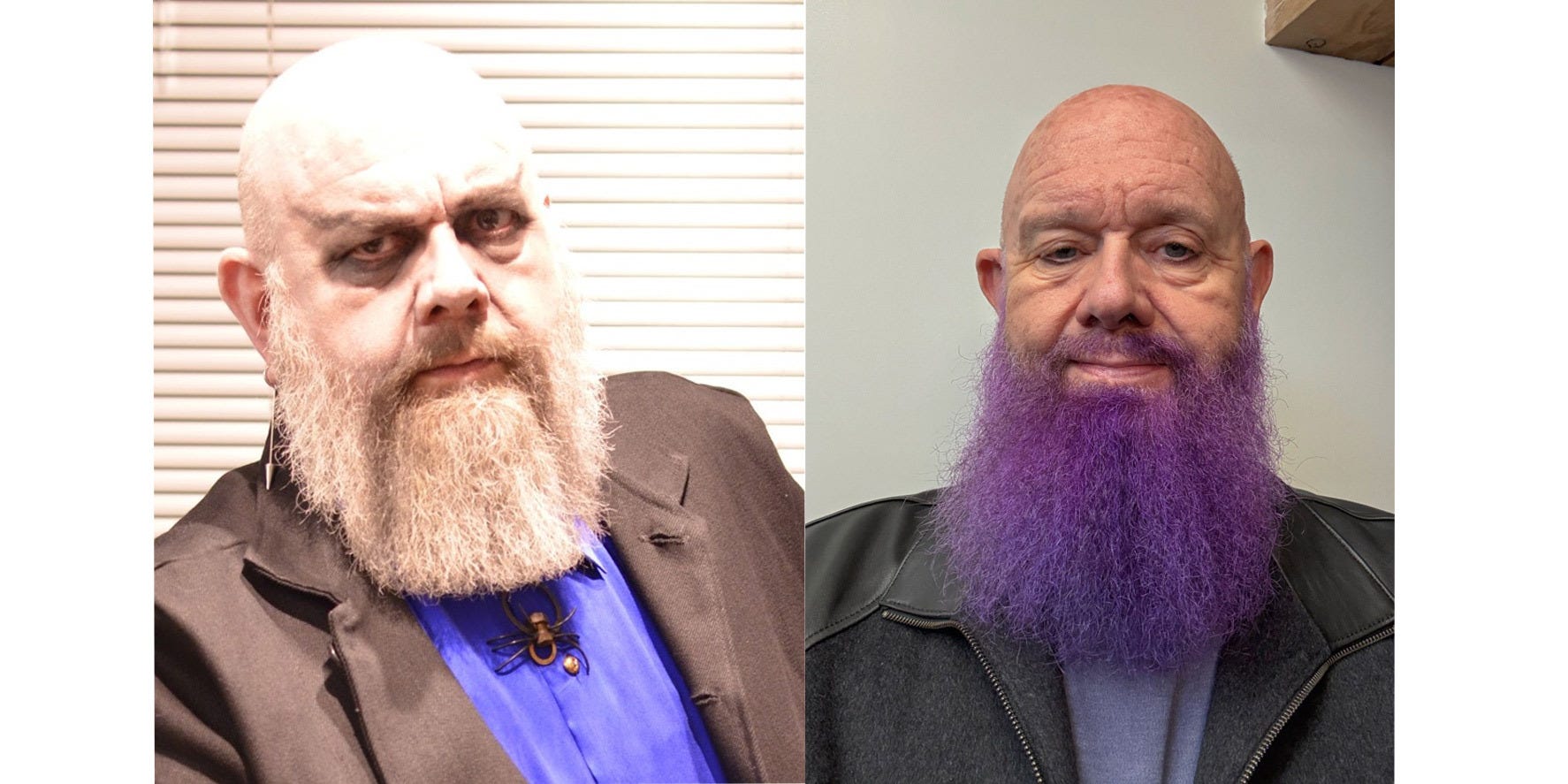
At nearly two meters tall, completely bald, with a white patriarchal beard and the general silhouette of someone who has opinions about order — I broadcast a signal I never chose and cannot revise.
Large male stranger. Notice first, evaluate later.
Evolution wired that response. It doesn’t consult my intentions. It doesn’t care that I am genuinely curious about people, that I find strangers interesting, that I would rather hear your story than tell you mine. It reads the outline and delivers a verdict before I’ve opened my mouth.
I couldn’t change my height. I couldn’t change my face. The variables that produce the signal were not available to me.
What I could change, it turned out, was the beard.
I dyed it purple before an event where vibrant hair was common — a small gesture of solidarity, intended to last one evening. I expected it to be a joke. Instead, strangers began stopping me several times a day.
“I love your beard.”
And then — the interesting part — they would tell me something real. A dream they hadn’t pursued. An identity still in formation. Something they didn’t usually say to strangers.
The signal had changed. The response had changed with it.
Not because I had changed.
Because one variable — only one available — had been different.
Here is what the purple beard actually did.
The original signal said: authority, size, unpredictability, possible threat. The nervous system of a stranger processes that signal in milliseconds and makes a recommendation: maintain distance, stay formal, don’t offer anything vulnerable.
The purple beard contradicted the signal. Not dramatically — it didn’t make me smaller or less imposing. But it introduced information that the threat-detection system couldn’t easily categorize. Someone who looks like a patriarch but has a purple beard is either dangerous in an unusual way, or genuinely not trying to project dominance.
It didn’t match any stored threat. So the amygdala stood down, and kicked it upstairs to the executive function.
They relaxed. They approached. They brought the real conversation instead of the managed one.
The beard was a permission slip. Not one I handed out deliberately — one the signal created by scrambling the original broadcast.
The purple beard is not a prescription. But the mechanism it revealed is transferable.
What the beard did was introduce a single element that didn’t fit the expected pattern. Not a disguise. Not a performance. One piece of information that the categorization system couldn’t resolve quickly, which forced a different kind of attention.
Call it deliberate incongruity.
The threat-detection apparatus is fast and efficient precisely because it generalizes. It runs on pattern recognition, not individual assessment. Large bald male — verdict delivered in under a second. The verdict isn’t malicious. It’s just the system doing what it was designed to do.
Incongruity disrupts the pattern before the verdict arrives.
It doesn’t need to be a beard. The signal you’re currently broadcasting is assembled from dozens of variables — some chosen, most not. What you wear, how you move through a room, where you position yourself, the pace at which you speak. Most of it you inherited from context: profession, culture, habit, the accumulated signals of people who looked like you.
The question is which variables are actually in your hands.
Appearance is the most obvious lever. Clothing and accessories carry signal in both directions — they can amplify the broadcast you’re making or introduce a note that doesn’t quite fit the expected type. A small, unexpected detail does more work than a wholesale reinvestment. The professor in paint-stained shoes. The executive in a hand-knitted cardigan. The detail doesn’t redefine the signal — it introduces ambiguity into it, which is enough.
Manner does similar work, more quietly. Most people in authority fill the available time with words. Slowing down — speaking less than the situation seems to demand, pausing where others would accelerate — signals something the pattern-matching system doesn’t know how to file. The space reads as confidence, or curiosity, or simply as someone who isn’t performing. All three invite a different kind of engagement than noise does.
Context works too, and it’s the most underestimated variable. Where you put yourself and what you’re seen doing rewrites the broadcast before you’ve opened your mouth. The signal a large imposing man emits leaning forward in a conference room is not the same signal he emits leaning back in a coffee shop with a battered novel. Same body. Completely different read.
The mechanism in each case is the same: the pattern doesn’t complete. Something doesn’t fit. The stranger’s attention, which was about to move on, stops instead. And in that moment of hesitation, the actual person becomes visible.
Not because the signal changed.
Because one variable made it legible.
This is the part worth sitting with.
The advice to change yourself usually points inward: examine your assumptions, regulate your reactions, do the interior work. That is real and it matters. But it operates on a different timescale, and it addresses a different problem.
The signal problem is exterior. It is the gap between who you are and what you appear to be — between your actual intentions and the broadcast your presence makes before you’ve said a word.
You cannot always close that gap from the inside.
Sometimes the gap closes when you change the signal.
And the leverage point is almost never where you expect it.
You will probably not dye your beard purple. That is not the point. The point is that you are already broadcasting something — a combination of appearance, manner, context, habit — that the people around you are reading constantly, largely without awareness, and responding to as though it were fact.
Some of that broadcast you chose. Much of it you didn’t.
The question worth asking is not how do I change myself?
It’s what signal am I sending that I never decided to send — and what is the one variable I actually have?
You may not have as many variables as you’d like. That is often true.
But you probably have more than one.
And sometimes one is enough.
Shakespeare said “All the world’s a stage, and all the men and women merely players.” A corollary of this is that “All clothing is costume.” Is the role your outfit says you are playing the one you want?