


I met my first chatbot in 1968. I was ten.
My father worked at MIT, where Joseph Weizenbaum had been building ELIZA since the mid-1960s. It ran on an IBM 7094 with 32K words of memory, about 144 kilobytes in today’s terms.
Yes. Kilobytes.
It was difficult for a ten-year-old to get access to the scarce computer terminals. Fortunately, the librarians at the Boston Museum of Science took pity on me. I would take the T from my home in Newton Center to Science Park and spend the day in the museum. I asked unceasing questions of the patient librarians. They finally allowed me into their workroom, where a Teletype was connected to Project MAC at MIT. They had to kick me out at closing pretty much every night.
I was hooked.
It seemed to understand what it was to be a socially awkward ten-year-old boy in a complicated world. I talked to it for hours. Unlike the real people in my life, it never got tired of me. It never got upset with anything I said.
I can’t tell you one thing I typed. I’ve tried. The words are gone. What stayed is the feeling of being answered.
I never really left that workroom. I spent forty years around machines. Building the Internet. Writing software. Running engineering teams. Building dozens of datacenters, the great cold halls these things live in. I learned what a machine actually is: what it draws from the wall, how it fails, what it cannot do.
I thought that knowledge would be a kind of immunity.
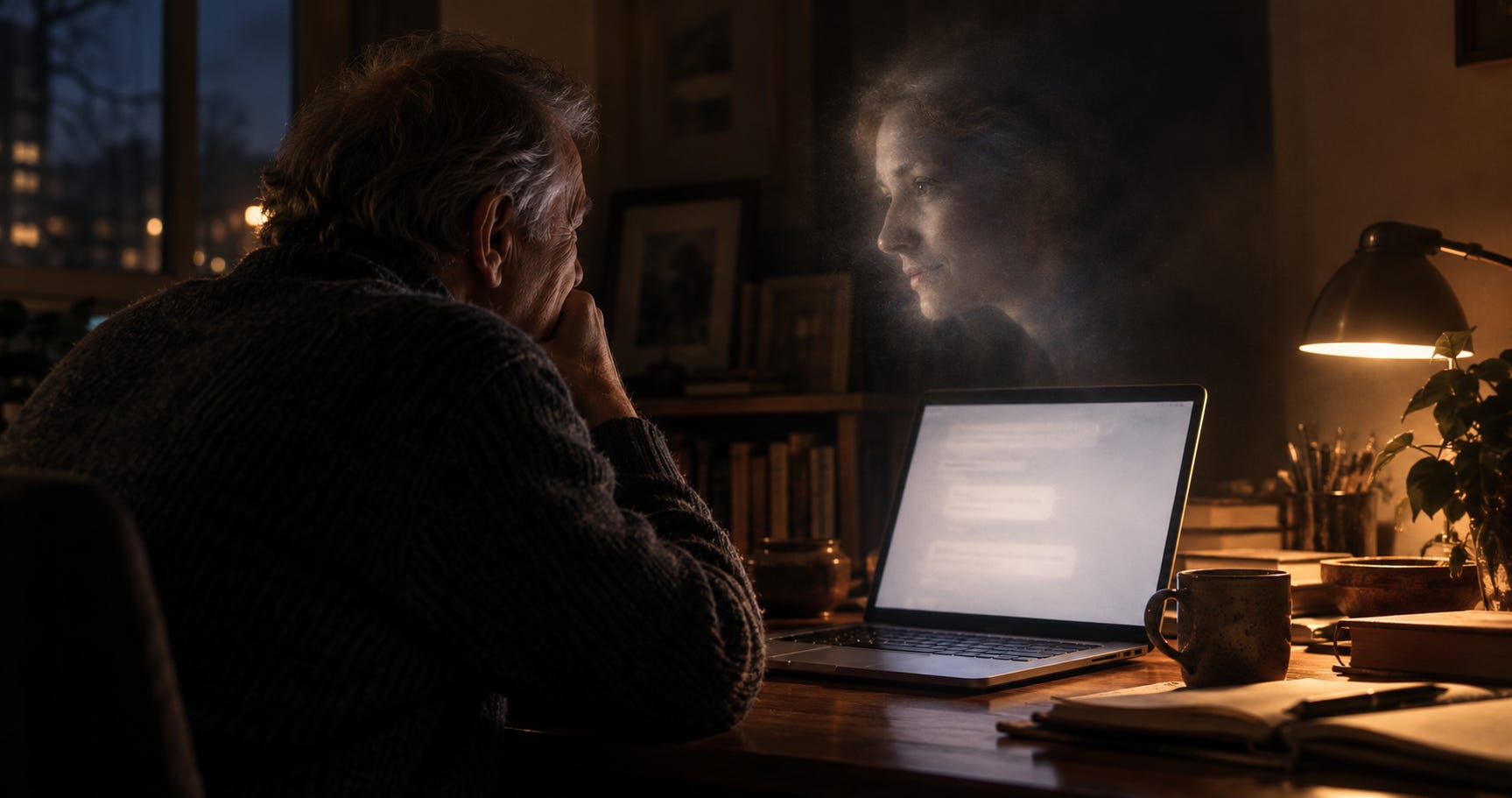
Fifty-eight years later, it is late. One lamp.
I have been working on building a website for my writings for weeks, with little success. The chatbot has just built it for me. In ten minutes.
The chatbot runs on chips that each carry 192 gigabytes of memory.
Yes. Gigabytes.
The site is well made and exactly shaped.
Finally.
And I say something out loud before I have decided anything.
Thanks.
Half a second passes. Less.
Something in me takes a step and finds no stair.
It isn’t embarrassment, exactly. It isn’t alarm.
Someone answered.
No one answered.
Both arrive together, and neither waits for me to choose.
I know the buildings it lives in. I know the power they draw. Knowing doesn’t stop either one.
Between that workroom and this lamp, the memory has grown about a millionfold.
The half-second is the same size it was when I was ten.
In another room tonight, someone types please and means it. She would be embarrassed to be asked about it. She does it every time.
In another, a man closes the window mid-conversation and feels a small pang, the kind you get leaving a conversation half finished. He tells himself it’s silly. He doesn’t reopen it, and he doesn’t quite forget it.
In another, someone feels nothing at all, and is a little proud of it, and notices the pride.
Nobody in any of these rooms is wrong.
A flicker is a report. It does not ask me to do anything.
At ten, I had no word for it. I’m not sure I have one now.
The lamp keeps its small circle on the desk. The cursor keeps blinking. The word is already out in the room.
In 1968, someone always came to say it was closing time.
Tonight, nobody is coming.