


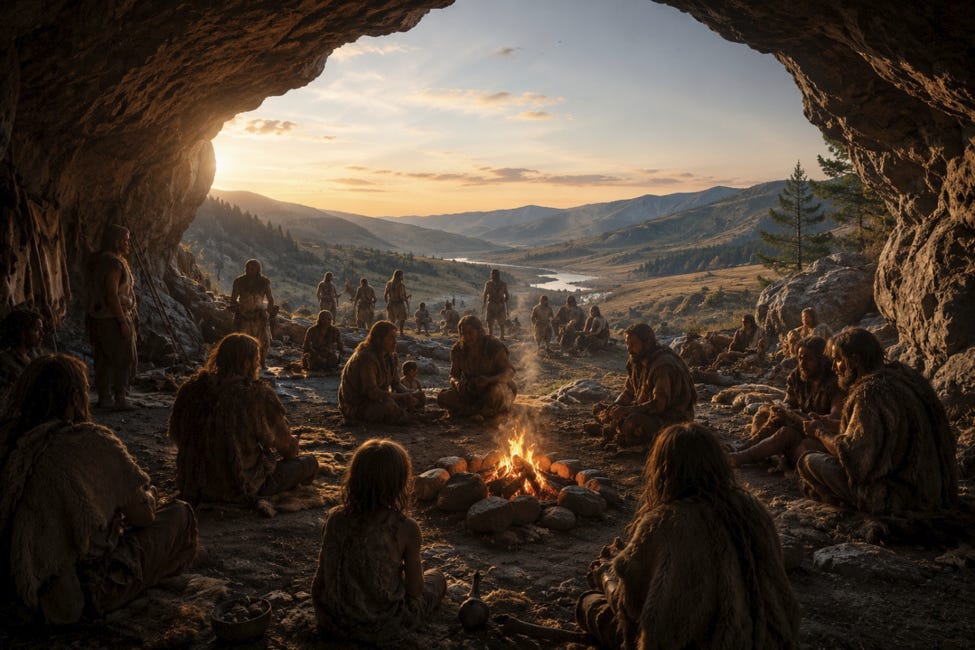
Our ancestors in Pleistocene tribes were with each other all the time.
We slept in the same cave or camp, we traveled together, we ate together, we hunted or gathered together. Our birth was witnessed, as was our death.
There were perhaps 50 of us in each foraging camp, two or three camps in each tribe — a total of perhaps 150 people whose names you knew, whose history you carried, whose state you tracked without being told. We intermarried between camps.
This is the social architecture the human nervous system was built inside. Not occasionally present with familiar people. Continuously present. Constantly embedded in a web of mutual awareness that required nothing to maintain, because it was simply the condition of being alive.
What that continuous presence was doing is not what we usually call it.
Not socializing. Not community building. Not even friendship, in the modern sense. Something more structural: running the nervous system in the operating conditions it was calibrated for. The brain’s threat-detection systems, its stress regulation, its sense of safety — all calibrated for a world where 50 people knew your name, your situation, your particular difficulties, without ever being briefed.
The information didn’t have to travel because it was ambient. It wasn’t transmitted; it was present. Someone knew you were struggling because they had been watching you for twenty years, eating with you every day, sleeping in the same space. The knowledge was simply there.
Then the conditions changed.
In a few centuries — nothing, in evolutionary time — the architecture was replaced. Cities. Mobility. Anonymity. Scale. Not bad trades, most of them. The goods are real: freedom to construct your associations rather than inherit them, freedom to leave, freedom to become someone the tribe didn’t expect. Real liberation from real constraints.
But not the same substrate.
Modern connection requires invitation. It requires scheduling, explanation, maintenance. You have to know you need something before you can reach for it. You have to communicate your state in order to receive response. Every relationship is, in some sense, a project: something that requires ongoing work simply to persist, and active investment simply to deepen.
The 50 people who knew you didn’t work that way. They were there whether you were at your best or your worst, whether you asked or didn’t, whether you had words for what was happening or not. The ambient knowing required nothing of you because it was a condition of your existence, not an achievement of your effort.
Here is what the absence does.
When the system doesn’t have access to what it was calibrated for, it still runs. You build connections. You invest in relationships. You fill the calendar. The connections are real. The calendar fills. And something underneath all of it runs at a slight, persistent remove — looking for what isn’t there, not in distress exactly, but not quite at rest.
This is the drive-home feeling, seen from underneath. Not a social failure. Not a deficit in the relationships available. A nervous system operating in an environment it was never calibrated for, running a search for a substrate the activity doesn’t provide.
The loneliness that persists after the successful evening is not a sign that the evening wasn’t good. It is the baseline condition of a system running without what it was designed for. The evening, however warm, cannot be what the 50 people were.
That condition has a name now. It does not have a cure.
What it has is a shape. Living with a shape you’ve named is different from living with a shape you haven’t — not better, necessarily, but more honest. The reaching makes more sense when you understand what you’re reaching toward and why the available architecture keeps falling just short of it.
There is one more thing to understand about chronic absence of the baseline. The system doesn’t run without the substrate indefinitely and stay neutral. Over time, it adapts. And that adaptation — quiet, gradual, often mistaken for peace — is a different kind of problem.