


Welcome to the Human Zoo
If you’re reading this, congratulations—you’ve entered a workplace full of intelligent, accomplished adults who, under mild stress, occasionally behave like confused meerkats.
Don’t worry. This is normal.
Humans have big cortexes, confused egos, and deep, mysterious feelings about conference room seating arrangements.
This guide will help you understand why conflict happens, why smart people argue past each other, and how the deceptively simple tool of paraphrasing turns chaos into collaboration. We’ll use gentle humor, real psychology, and a few uncomfortable truths.

By the end, you’ll be able to manage conflict more gracefully—and possibly become the person everyone wants in the meeting.
Why Conflict Happens (Even Among Smart People)
Most workplace disagreements come from two extremely boring, extremely common sources:
Overloaded terms
Words like “simple”, “secure”, “done”, “efficient”, or “scalable” masquerade as shared language but actually hide entire philosophical worldviews.
Engineers hear “simple” and think *few moving parts*.
Designers hear “simple” and think *the user presses one button and angels sing*. Product managers hear “simple” and think *we can ship this tomorrow, right?*
TechOps folks hear “simple” and think “no changes for long enough that we can figure out what is already in production and make it work properly”
Imputed motives
Humans are mind-reading animals— with the accuracy of a horoscope written by an over-caffeinated squirrel.
We assume:
“He’s blocking me.”
“She’s trying to make me look bad.”
“They don’t care about quality.”
But often the truth is something far less dramatic:
They misunderstood the term.
They’re scared of failing.
Their cat threw up this morning and they’re emotionally compromised.
When you combine overloaded terms with imputed motives, you get conflict. Not because people are bad, but because human cognition was designed for small tribal groups, not the sprawling coordination puzzles we call ‘work.’.
Fear—The Quiet Puppet Master
Here’s the secret nobody likes admitting:
“Anger is just fear in a studded leather jacket”
People don’t yell because they’re strong. They yell because some trembling part of them believes:
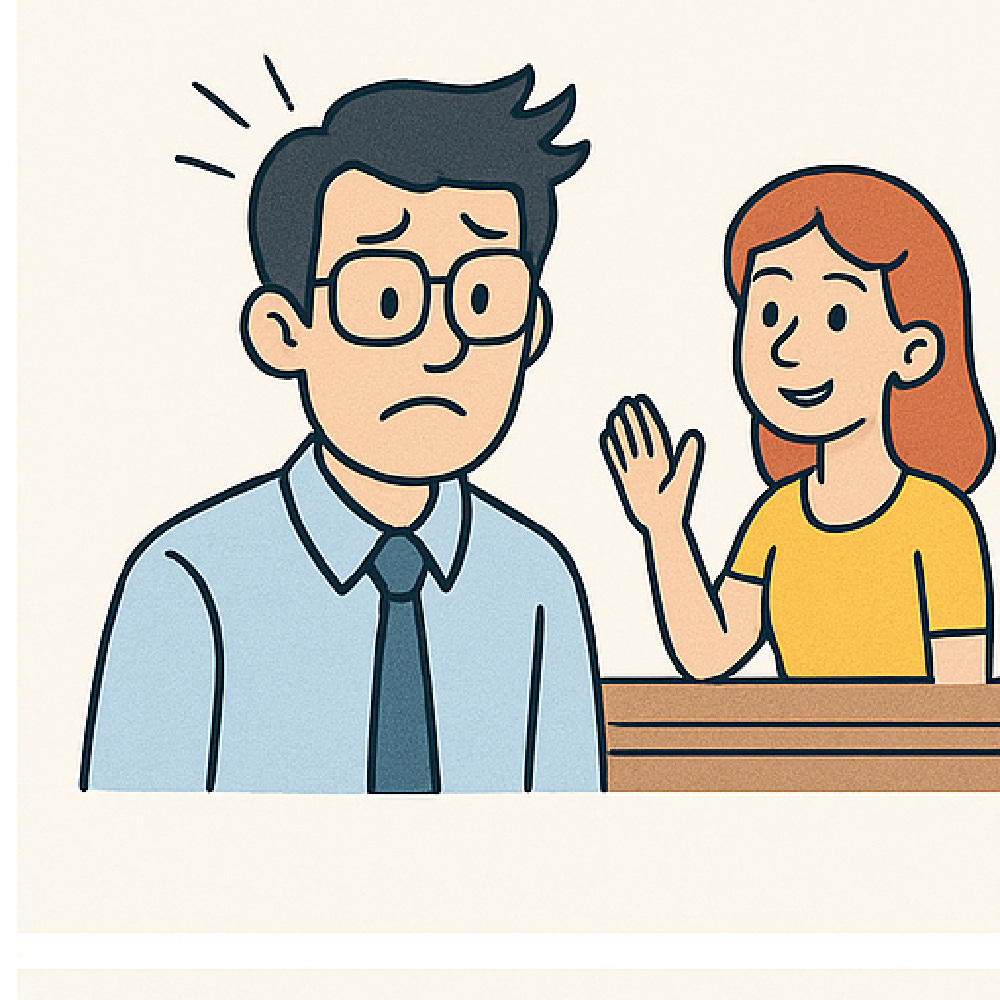
“I’m about to lose status.”
“I’ll look foolish.”
“I won’t be heard.”
“Someone will overpower me.”
These fears often come from childhood. Maybe authority was unpredictable. Maybe conflict meant danger. Maybe being wrong meant humiliation. Fast forward to adulthood, and suddenly the senior VP’s tone triggers your nervous system like you’re back at the dinner table in 1987.
This does not make you weak. It makes you human.
The most emotionally mature professionals aren’t fearless—they’re just skilled at noticing fear, naming it, and not letting it run the meeting.
Paraphrasing — The Jedi Mind Trick of Communication
Paraphrasing is the simplest tool with the highest ROI in human interaction. It is the WD-40 of workplace communication.
It works because it simultaneously:
Clarifies terminology - “When you say ‘done,’ do you mean working on your machine or ready for users?”
Disarms emotional defenses - “Let me see if I’m catching your concern correctly…”
Bridges disciplinary worldviews - “From a design perspective you want X; from engineering’s perspective Y is the constraint.”
Slows the conversation just enough - so that everyone’s amygdalas stop hyperventilating.
You’re not performing therapy. You are debugging the conversation itself!
When done well, paraphrasing makes the other person feel the rarest workplace emotion: understood.
And once someone feels understood, they stop defending, stop escalating, and start collaborating. It’s like turning off the emotional sprinklers.
Why Some People Resist Paraphrasing (And Why They Probably Shouldn’t)
Some employees adopt paraphrasing immediately. Their communication improves. Conflicts diminish. They get promoted.
Others resist it like a toddler resisting bedtime. Why?
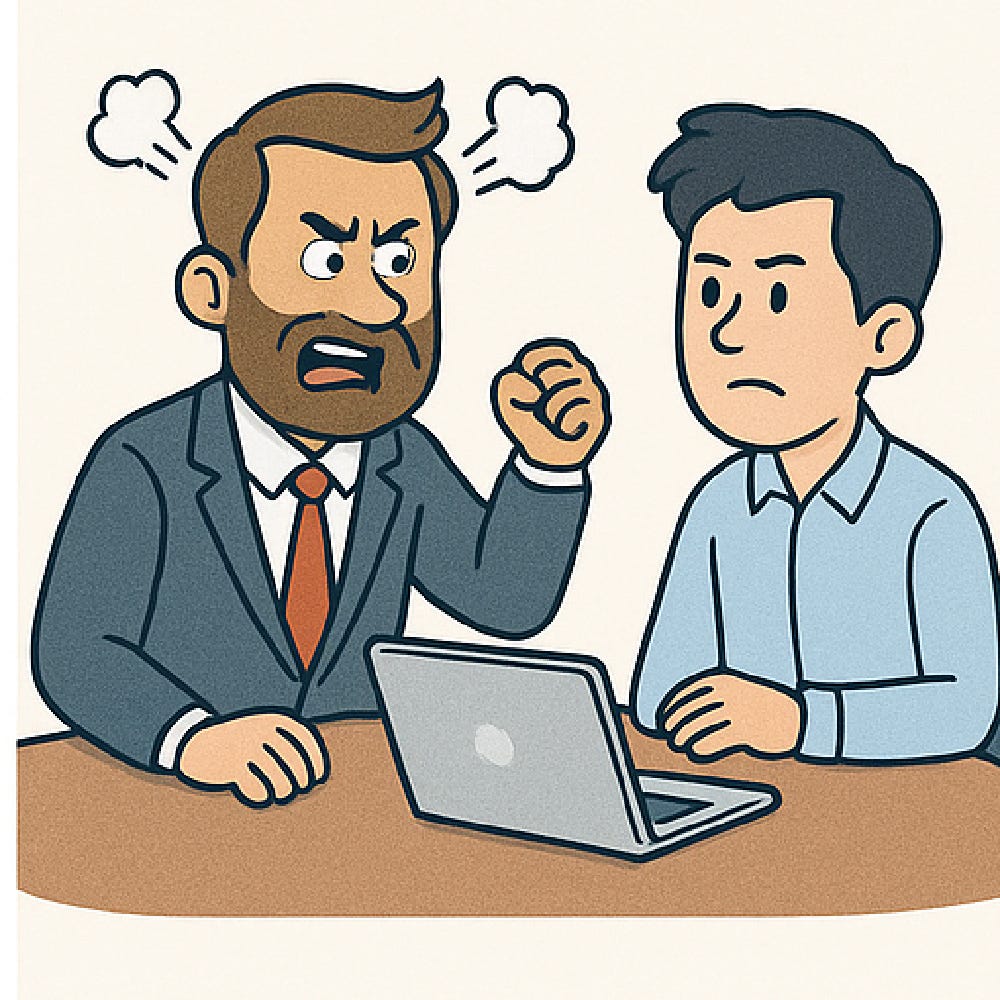
Not because they’re stubborn.
Not because they’re incapable.
But because paraphrasing requires vulnerability.
To paraphrase someone, you must admit:
“I might not have understood you perfectly.”
“Your perspective matters enough that I’m checking.”
“I’m willing to momentarily step out of persuasion mode.”
For people who grew up in environments where misunderstanding meant punishment, or where admitting uncertainty meant weakness, paraphrasing feels terrifying.
Ironically, it is the very tool that would make them feel safer—once they try it.
The Long-Term Advantages (a.k.a. Why Leaders Master This)
Here’s an open secret among good managers:
The best people aren’t promoted for how smart they are. They’re promoted for how little friction they generate while being smart.
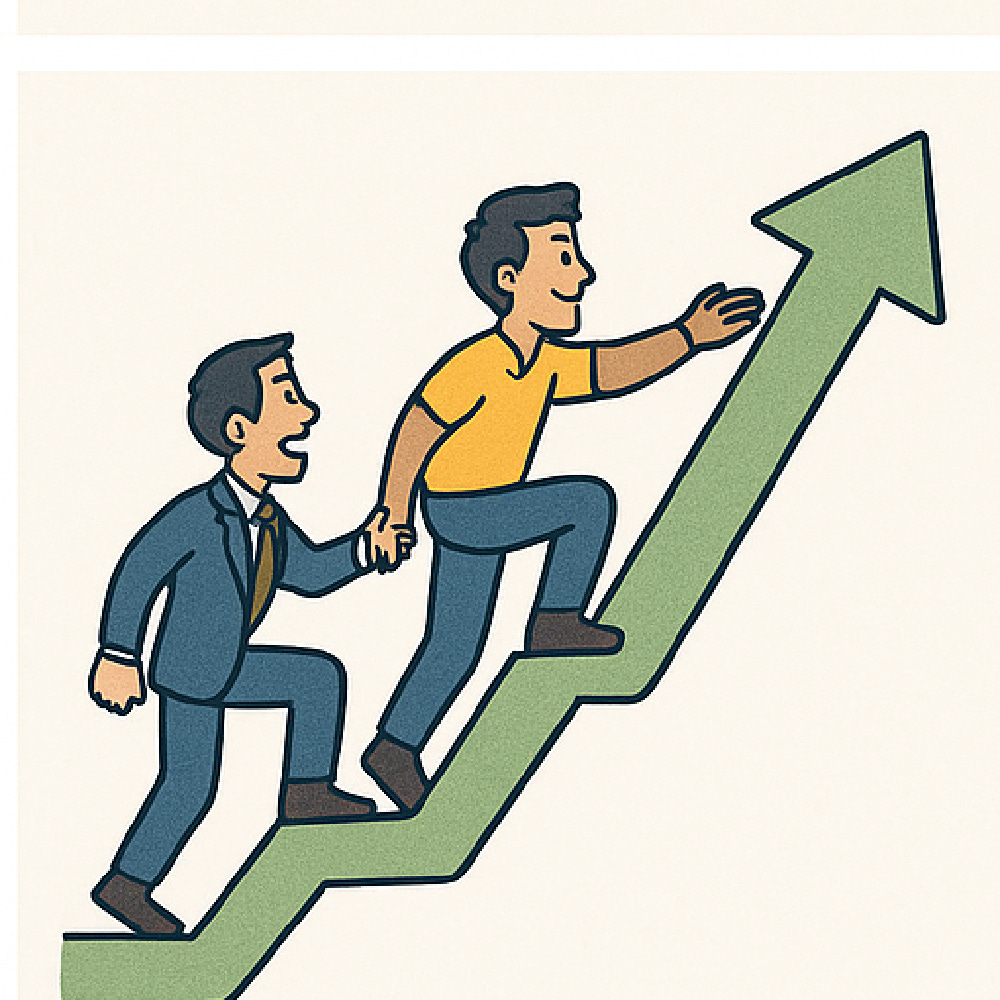
Paraphrasers:
Deescalate naturally.
Create clarity instead of confusion.
Unblock meetings without drama.
Make other people’s ideas better.
Become the person colleagues gravitate toward in crises.
Non-paraphrasers:
Keep fighting the wrong battles.
Confuse “assertion” with “influence.”
Mistake emotional noise for intellectual strength.
Eventually stagnate.
Skill in managing conflict compounds over time, like interest—small gains at first, but dramatic payoff later.
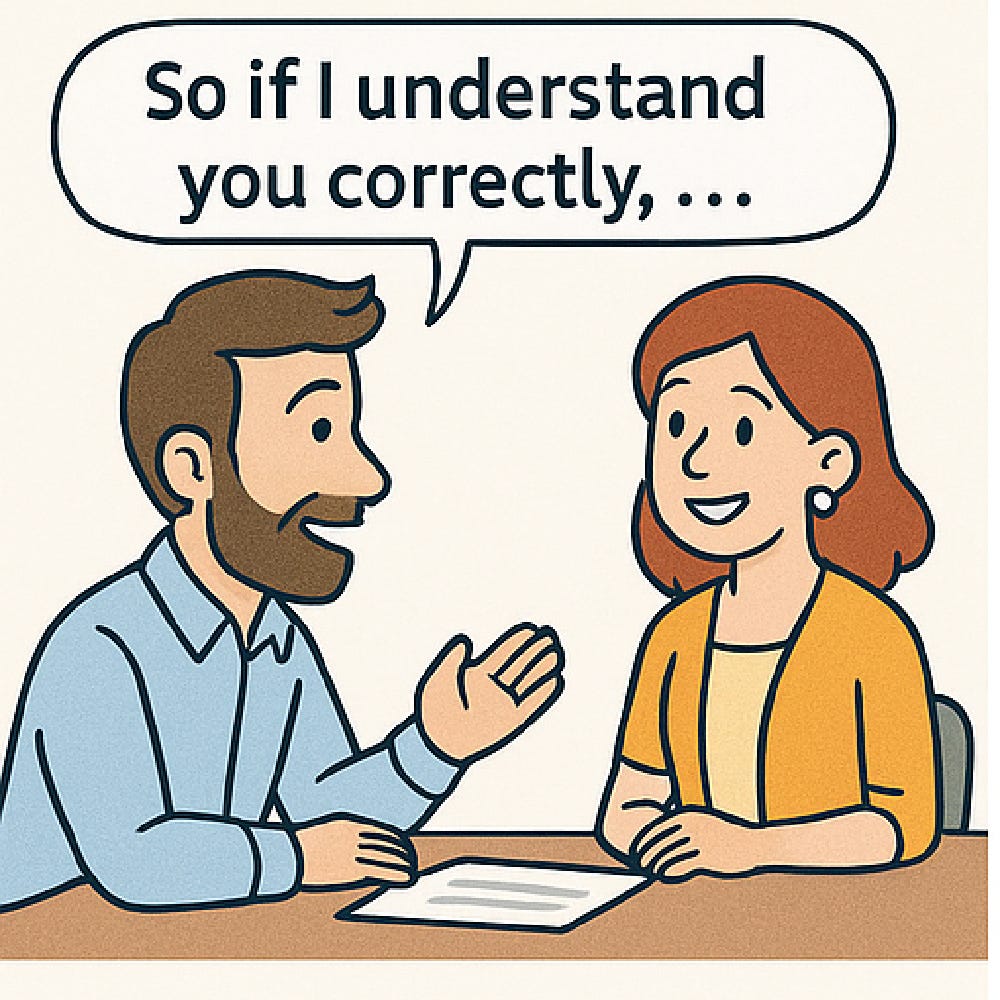
Don’t worry—you don’t need to say “Tell me how that makes you feel.”
“Let me make sure I’m tracking.”
“Here’s what I heard you say—correct me if I missed something.”
“When you say value, do you mean revenue, retention, or user happiness?”
“So your concern is X, and the tradeoff you’re worried about is Y—is that right?”
Paraphrasing is about
Clarify facts.
Clarify meaning.
Clarify emotion when relevant.
It’s lightweight, elegant, and effective.
Sitting in Discomfort — The Muscle No One Wants to Build
Modern workplaces reward fast thinking, fast shipping, and fast opinions. But emotional skill requires the opposite:
Pausing when your body wants to sprint.
Breathing when your ego wants to armor up.
Listening when your fear wants to interrupt.
Sitting in discomfort is not about tolerating abuse.
It’s about learning to let your nervous system ride out the wave instead of letting it drag you into the rocks.
When authority gets angry, your childhood programming might whisper:
“Stay small.”
“Stay silent.”
“Stay safe.”
But you can update that programming.
Every time you stay present without collapsing, your system learns:
*The danger is old. The moment is new.*
This is how leaders are formed—not by confidence, but by self-regulation under pressure.
Bringing It All Together — The Real Work of Being Understood
Here’s the quieter truth:
People don’t really want to win arguments. They don’t really want to dominate meetings.
They don’t really want to be right.
They want to be seen.
They want to be understood.
They want to not be alone in their perspective.
Paraphrasing gives them that. Understanding gives them that.
And when people feel understood, they generate less fear, less anger, and more creativity.
This is not just communication technique—it’s leadership philosophy.
Becoming the Calm in the Chaos
In every workplace, there are storms: misunderstandings, competing priorities, difficult personalities, emotional histories colliding with deadlines.
Your job isn’t to stop the storms.Storms are necessary to provide the energy to drive forward.
Windmills are useless without wind.
Your job is to become the high-pressure system that stabilizes and channels them.
Understand first.
Clarify second.
Contribute third.
This is how teams grow.
This is how organizations evolve.
This is how people heal old fears without ever naming them.
And who knows— years from now, someone might say you were the first leader who really understood them.
That’s not a soft skill.
That’s impact.