


Conflict rarely begins where we think it does.
It does not usually begin with disagreement. It does not usually begin with malice. It does not even usually begin with incompatible goals.
It begins inside interpretation.
A colleague interrupts you mid-sentence.
That is the data.
Before you are conscious of it, something else happens.
They don’t respect me.
They’re trying to undermine me.
This always happens.
The emotional shift follows the imputation, not the interruption.
By the time you respond, you are no longer reacting to behavior. You are reacting to a story.
The Ladder
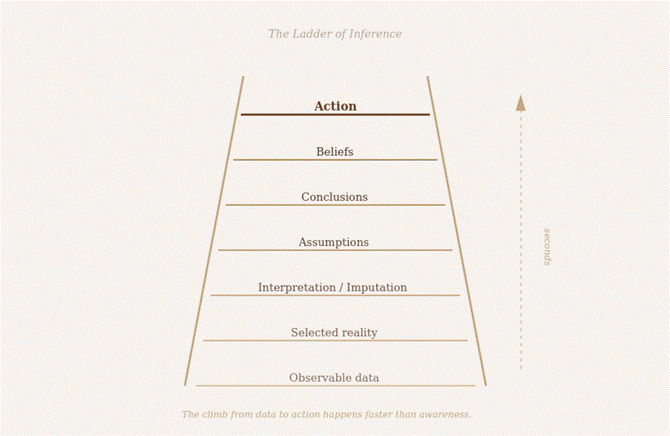
Chris Argyris called it the Ladder of Inference. (If the model is new to you, here is a short description: https://untools.co/ladder-of-inference)
The name is clinical. The pattern is not.
We observe something. We select part of it — not all of it, never all of it. We assign meaning. We infer motive. We draw conclusions. We act.
The climb takes seconds. And we feel it happening — the tightening, the certainty arriving before we’ve consciously examined anything. By the time we reach the top, we have left the event entirely. We are living inside the story we built on the way up.
At the top, interpretation feels indistinguishable from fact. That is the problem. Not that we climb — we have to. But that we arrive at conclusions and treat them as data.
That distance is where conflict lives.
Where Fear Enters
In a previous essay, I wrote about the gift hidden in pain — how discomfort is often signal, not noise.
The ladder complicates this. Because not all pain is signal. Some of it is data we have already altered.
What accelerates the climb is fear. We don’t just interpret — we interpret toward safety. The mind, threatened, moves fast. It selects the data that confirms danger. It assigns meaning that explains the threat. And it arrives at certainty before we’ve had a chance to ask whether certainty is warranted.
This is not weakness. It is ancient wiring doing exactly what it was designed to do. But in a meeting room, or a marriage, or a difficult conversation, the speed that once protected us now distorts us.
The emotional spike arrives when the meaning we have assigned threatens something essential — our standing, our belonging, our sense of being seen. The spike isn’t about the behavior. It’s about what we decided the behavior meant. And underneath that decision, almost always, is fear.
When Interpretation Becomes Identity
Conflict becomes durable the moment we defend the top of the ladder as fact.
They ignored me.
Becomes: They don’t value me.
Becomes: They always undermine me.
Now we are no longer talking about a missed email or an interrupted sentence. We are talking about character. About a pattern. About who someone fundamentally is.
This is where interpretation becomes imputation — we stop reading the event and start reading the person. And that is where the real damage happens. Not in the conflict itself, but in what the conflict does to our perception. We stop seeing the other person as complex. We reduce them to the story we built about them. They become a type: the dismissive colleague, the unreliable partner, the person who never listens.
Reduction is a form of protection. If I know what you are, I don’t have to stay open to what you might be. But it comes at a cost. We lose contact with the actual person — and we lose the possibility of anything different happening between us.
Most conflicts that drag on are not about the original event. They are about the reduction that followed it.
The Obvious Objection
Here is the honest pushback: sometimes the interpretation is correct.
Sometimes people really are dismissing you. Sometimes the pattern you identified is real. Sometimes your read on someone’s motives is accurate.
Yes.
But the discipline is not about doubting reality. It is about slowing the climb long enough to find out.
Even correct conclusions benefit from verification. The person who pauses to check their inference is not weaker than the person who acts immediately on it. They are more precise. And precision, in conflict, is mercy — for the other person and for yourself.
Clarity before confrontation is not hesitation. It is hygiene.
The Discipline of Descending
Most of us know how to climb the ladder. We do it automatically, efficiently, without effort.
Almost no one has been taught to descend it.
Descending is not passive. It is not the absence of response. It is a set of deliberate questions asked at the right moment:
What did I actually observe?
What meaning did I add to it?
What else could explain this?
What part of this reaction is about me?
That last question is the hardest. Because some of what activates in us during conflict is not about the current moment at all. It is older. It has a history. The colleague who interrupted you might be unknowingly landing on a bruise formed by someone else entirely.
Descending the ladder does not mean finding out you were wrong. Sometimes you find out you were right. But you find out — rather than assuming — and that difference is not small.
The Leader Who Cannot Descend
I have worked with leaders who climbed fast and stayed there. They overreacted. They personalized. They escalated situations that a single clarifying question would have dissolved.
They were not bad people. They were fast climbers without a way down.
The cultures they created reflected this. Fragile. Reactive. Exhausting. Every ambiguous signal became a referendum on loyalty or competence or respect.
The leaders who moved differently had something in common. Not that they were slow. Not that they were passive. But that they could separate observation from story quickly enough to stay in the former while the latter was still forming.
That is a skill. It can be built. And it produces something rare: influence that does not require noise.
What We Lose at the Top
We climbed the ladder again today. We all did.
Someone said something ambiguous and we decided what it meant. Someone was quiet when we expected warmth and we drew a conclusion. Someone acted in a way that could be explained by a dozen things, and we chose one — usually the one that confirmed what fear was already whispering.
The problem is not that we interpreted. Interpretation is how we function. The problem is that we did not notice we had — and so we responded to the story as though it were the event. We reduced a person to a pattern. We closed off what might have been possible between us.
Conflict rarely begins at the bottom of the ladder.
It begins at the top, where interpretation feels indistinguishable from truth, and where the person in front of us has quietly become something smaller than they are.
The discipline is not to stop climbing.
It is to recognize when you have.
And to descend before you lose them.